
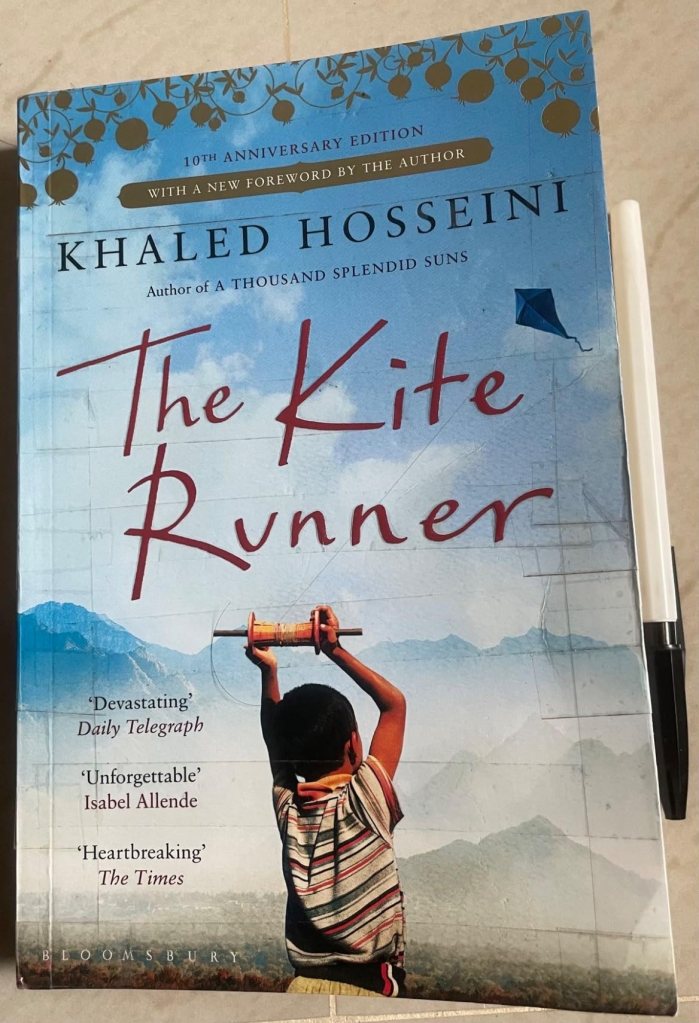
Unless you are living under a rock, you must not have missed the words “For you, a thousand times over”. You may have chanced upon them in emotional reels, in quotations, as someone’s status or a line quoted on YouTube or in podcasts. If you are a reader, then you know where it comes from and the weight of the emotions that lie within these words. You feel the rawness and the power these simple words bear. But my experience of The Kite Runner extends far beyond these often quoted lines. The characters, their storylines, their development, and the human psyche, as described in this book, are hard to forget.
No matter how many times I read The Kite Runner, I keep coming back to Amir’s character arc and the quiet, almost haunting presence of Hassan.
Amir is, of course, a character central to the plot, but also not a character that you admire. His deeply ingrained insecurity leads him to constantly seek his Baba’s approval and validation, while he continues to resent Hassan just to please everyone else around him. While reading the book, you initially feel that he’s someone who doesn’t deserve Hassan’s loyalty (and he also knows this). What then makes his journey powerful? Is it his confrontation with the worst version of himself or the wound that he carries for ill-treating Hassan? Is it about the manner in which guilt shapes his life,or his journey back to Afghanistan being synonymous with walking back into his own conscience?
Somewhere along the way, do we start empathising with the character? Who hasn’t been in situations that they look back at with a tinge of guilt, or a feeling of “should have done this or that”? In fact, realising and having an inner voice telling us when we were wrong is the very first sign of character development. At least you are not blinded by arrogance. That is essentially what makes us human.
And then there is Hassan.
A character with so much stillness that you almost don’t realise how deeply he affects you until much later. He doesn’t have the complexity or inner conflict as Amir does, but what makes him different is how constant he is in a temporary world. His loyalty, his kindness, and, most of all, his purity make his story so devastating. There’s an innocence in him that feels so sacred, that watching it exist in a world that is so harsh and unequal breaks your heart.
Kite Runner is a book that speaks to you through silences, through missed chances, and unsaid things. It has no single incident of explosive guilt but a guilt that lingers on. There is no declaratory grand love but one shown in small, almost invisible acts. And the pain… the pain comes from knowing that some moments cannot be undone, and some wounds remain unhealed, even with time, which makes it even more relatable!
Why would you read such a dull, pulling-your-spirit-down kind of book? It is because of how it deals with redemption. Redemption does not come as it does in movies, that someone apologises and there is a clean slate. It is presented in the most natural human way; Amir doesn’t get to erase what he did. He can only try to live in a way that acknowledges it. And perhaps that’s the most honest part of the story: that redemption is not about undoing the past, but about having the courage to face your wrongs. Amir’s entire journey feels like an attempt to reach a place where he can finally be worthy of the kind of love Hassan gave so freely.
It’s not a story that gives you comfort. But it gives you something more lasting. a quiet, persistent ache, and a question you carry with you long after: what does it really mean to be good again?
It is a reminder of everything Amir failed to be, and everything Hassan quietly was.

So if you ask me if I will revisit the book again , I remember the emotional turmoil this book made me feel and say, “For you, a thousand times over”.
 whatithoughtoftoday.in
Leave a comment