
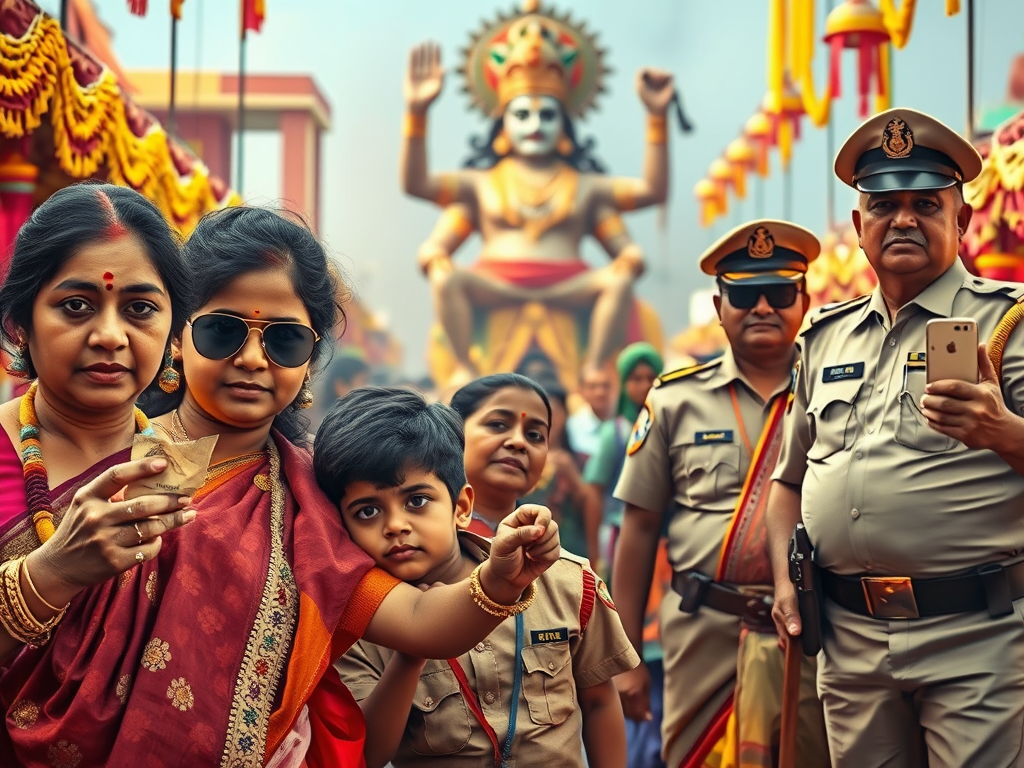

A girl and her mother decided to visit the Dussehra fair organized in their town. They started their day with a visit to the temple, where they joined the queue for purchasing Prasad to be offered to God.
The lady standing in front of them in the queue was purchasing prasad, and the shopkeeper informed her that the total cost was 111 rupees. Initially, she took out a crisp 100 rupee note, a 10 rupee note, and a 1 rupee coin to pay. However, at the last moment, she had a change of heart. Slyly, she put the 10 rupee back in her purse and craftily replaced it with a worn and torn 10 rupee note. Given the bustling crowd, the shopkeeper failed to notice the switch and accepted the torn note, which appeared practically useless. The lady happily took the prasad and proceeded, secretly pleased with herself for getting rid of the tattered note.
Just then, a young boy, around 10 years old, came running to the shopkeeper and requested 21 rupees’ worth of prasad. When asked about his parents, the child explained that they had gone inside the temple and entrusted him with the task of acquiring the prasad. Observing that the child was unsupervised, the shopkeeper devised a shrewd plan. He decided to dispense laddoos from the old stock to the boy instead of fresh prasad. Satisfied with his cunning tactics, the shopkeeper counted it as a minor victory.
As they entered the temple premises, the girl and her mother noticed an old lady struggling to balance her prasad along with her walking stick. She kindly asked the boys who were overseeing the devotee’s purse and shoes for assistance. However, the boys, perhaps preoccupied with their responsibilities, firmly refused.
Shortly after, a young lady, who seemed to hail from an urban city and exuded an air of sophistication with her sunglasses and expensive perfume, approached the attendants. In her accented tone, she requested that they hold her thaali for her, explaining that she didn’t want to risk ruining her manicure.The attendants responded with tact and asked the young lady to pay for the service. They were swayed by her apparent affluence and chose to assist her .
Inside the premises some were preoccupied with selfie sticks, busy capturing every moment and vlogging about their temple visit. Tourists and devotees were jostling about, trying to document their spiritual journey for the world to see.
In a quiet corner, they saw pandits requesting alms, especially from tourists, in exchange for conducting auspicious prayers in the temple’s inner sanctum.
While mother and her daughter were trying to focus on their prayers, they overheard a lady engaging in a gossip session with another lady, right in the middle of the temple. She was asking intrusive questions about when her husband’s retirement is due, the whereabouts of her children, how much they are earning, and other petty details. This behavior seemed inconsiderate and intrusive, especially in a place where one should ideally pray in peace.
When they moved on to light their incense sticks, they encountered another lady who asked them to share their matchstick with her. However, to their surprise, she cleverly snatched the entire box and made a hasty escape. Undeterred by this unexpected incident, the mother and daughter sought the assistance of a nearby lighted diya to ignite their incense sticks and continued with their prayers, maintaining their focus and composure in the midst of the chaos around them.
As the girl and her mother were leaving the temple, they witnessed a heavy police presence, with officers clearing the street and telling beggars and others to make way. An honorable Member of Parliament (MP) was about to visit the temple, and they were relieved they had left in time. VIP visits often meant the entire area would be commandeered, and the temple could temporarily become the MP’s private domain.
They also noticed that the priests were prepared with a bag of cash, which they would cleverly offer to the minister in the guise of prasad, seeking favors in return.
As they continued on their way, a poor dog rushed toward them, followed by a group of boys attempting to tie firecrackers to its tail. The mother and daughter scolded the boys, who quickly fled, leaving the dog shaken. They decided to comfort and feed the frightened dog, showing kindness and compassion.
Moving towards the field where the effigy of Ravana was to be burned, they encountered a massive crowd.
Upon reaching the main field, they found a frenzied crowd, with people jostling for prime spots and some individuals eyeing women’s purses. The same prominent, pot-bellied politician took the stage and delivered a speech, emphasizing the significance of Dussehra, the triumph of good over evil, and the need to conquer one’s inner demons. The police officers, the prasad shopkeeper, the priests, and the chatty aunties all nodded in agreement.
As the effigy of Ravana burned, the crowd cheered in unison. In this moment, the boys who pursued the dog, tourists, bloggers, the lady with the torn note, those who had helped tourists but not the lady in need, and the pushing, grabbing crowd, all celebrated the symbolic victory of good over evil.
The mother and daughter went home and reflected on how festivals are also a chance where we must remind ourselves to confront our own inner demons, whether it is through the subtle deceptions we may engage in or the small ways we try to take advantage of others. It’s a time to ask ourselves whether we truly embody the values we celebrate during the festival. By combining the external festivities with inner reflection and personal growth, we can ensure that these celebrations become meaningful, transformative experiences that extend beyond the symbolic burning of Ravana
 whatithoughtoftoday.in
Leave a comment